LLC Subchapter SClose the month, then elect
The company already exists. The federal election is a separate filing, and it changes which return that company files. Meet Steven Palmieri, Tax CFO. Also called the Entrepreneur's CFO. The month gets closed first.

Tell us what is filed

You will be talking to the Steven Palmieri practice.
The Tax CFO way.
An accountant counts what already happened. A Tax CFO decides what happens next: whether the form leaves this year, what wage the work supports, and which date the year can still use.

The letter can arrive late
A late request needs a reason on paper. Working until morning does not grant it.
Click to see a late filing ›Tap to see a late filing ›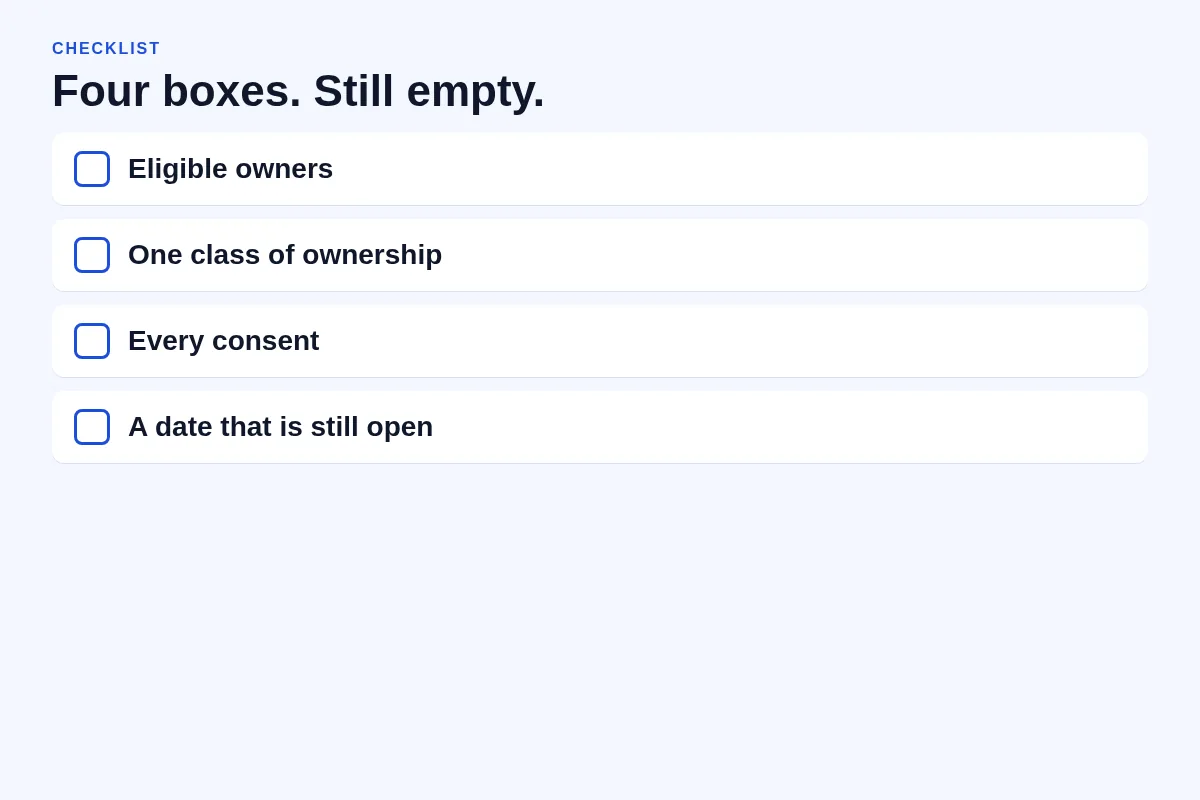
A shop still needs a closed month
A receipt from the counter is just a receipt until a month says whose it was and which year owns it. The return stands on that month.
Click to see the closed month ›Tap to see the closed month ›Four answers before the form
Eligible owners, one class of ownership, every required consent, and a date.
Click to see the four gates ›Tap to see the four gates ›Two papers, not one company
The state paper creates the company. The federal paper elects the return. Ordering a kit does not finish either one.
Click to see the two papers ›Tap to see the two papers ›The form can leave too early
Mail the form before those gates and the year can open on the wrong date.
Click to see the early form ›Tap to see the early form ›One form is often enough
The election form usually asks to be taxed as a corporation at the same time. A separate classification form is a different path.
Click to see which form ›Tap to see which form ›Six letters before the election
Open one letter. It names the paper, who should touch it, and the fact that paper does not replace.
1An acceptance letter with a date on it
We file that date next to the year it covers
Mailing the form is not the same event as the letter that says the election took.
2A note that the filing arrived after the window
We ask whether the company already lived on the elected return
Late relief is a request with a reason. It is not a promise, and it is not a story about a long night.
3Pay went out and no payroll login exists
We set the provider up in the company's name
Wages and a draw are different movements of cash. The provider runs payday. We stop at setup.
4The K-1 and the owner's draws do not tell one story
We rebuild the year from closed months
The schedule the owner receives is an output of the books. It cannot invent a month that never closed.
5Two owners took cash in different patterns
We test whether ownership is still one class
Uneven cash can look like a second class even when nobody wrote a second class into the papers.
6The federal file still treats the company as a partnership
We look for the election, not a new state certificate
A default classification stays in place until a filing changes it. The company itself does not have to be reborn.

Steven Palmieri
Tax CFO. The Entrepreneur's CFO. Election work here is a closed month, a payroll login, and a return that can point at both.
Bring the letter or the draft
You will be talking to the Steven Palmieri practice.
What the election actually changes
A company with one owner usually starts as a disregarded company. A company with more than one owner usually starts as a partnership. Neither of those is a moral fact. They are the federal defaults. The election is how that default gets replaced for a year you name. What we arrange, when wages belong in that year, is the payroll login. The click that sends pay is not ours. It belongs to whatever payroll company the owner already uses. The count behind that decision is the months that already closed and the cash that already left. We check the four gates, close the month, and only then does the envelope go.
After an acceptance, the company files its own return and each owner receives a schedule of the year. Money the owner takes is no longer one bucket. Wages go through a payroll provider. What is left, when the books support it, is a distribution. Mixing those two is how a clean year becomes a letter later.
No page here names a dollar of tax saved. Profit, wages, and the owner's other income move the answer, and a page cannot see them. What a page can say is the order. Close the month. Separate wages from other cash. Then talk about the election for a year that is still open.
A receipt is not yet a month
Picture a shop on an ordinary afternoon. Someone pays, a receipt prints, and the drawer closes. That slip does not know whether it was a supply, a draw, or a payment on a loan. The month is the conversation that sorts the slip. Until that conversation happens, the return has nothing honest to stand on.
Owners often arrive with a year of slips and a sentence they heard at a dinner. The sentence is that the election will make the year cheaper. The slips are still unsorted. We start with the slips. The election is a later sentence, and only for a year whose months can be closed.
What we will not pretend
We will not say the election is already in place because someone formed the company. We will not say a late request is granted because the reason feels fair. We will not run payday. A provider does that, after the login and the pay items exist in the company's name.
If the ownership cannot be one class, or a required person cannot consent, we say so before a form goes out. The first look is allowed to end with "not this year." That is a useful answer. It keeps a bad filing out of the file.